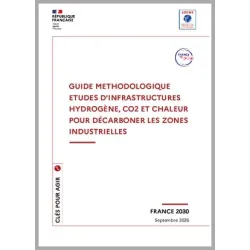
Guide méthodologique pour le cadrage de l'étude de trajectoires de décarbonation d'une ZIBAC
Guide
Mis en ligne le : 04/11/2025

France 2030
In 2022, the government invited industrial zones across France to apply for the newly created “ZIBaC” (“Low Carbon Industrial Zone”) status, as part of the ‘France 2030’ national investment programme. The aim is to support industrial areas as they transition to a low-carbon, energy-efficient future, helping them to become more resilient, more competitive, and more attractive.
Following the call for proposals, a total of ten industrial zones were selected to carry out early-stage studies to prepare for significant decarbonisation investment. The approach adopted in these low-carbon industrial zones is based on strong, collective local governance, enabling partners to define clear, evidence-based decarbonisation pathways going forward to 2030 and 2050.
This document contains methodological guidance and working assumptions to help project leads build these pathways collaboratively. The aim is to develop contrasting scenarios in order to identify the conditions required to meet decarbonisation targets.
It is aimed at the ten industrial zones selected, and any other industrial zone or group of industrial enterprises interested in committing to a forward-looking decarbonisation initiative of this kind.
Documents associés
Guide
Mis en ligne le : 04/11/2025
Guide
Mis en ligne le : 04/11/2025

Guide
Mis en ligne le : 10/11/2026
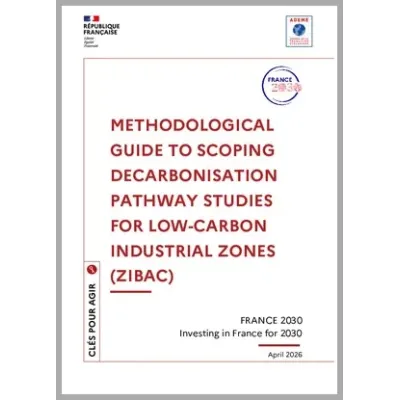
METHODOLOGICAL GUIDE TO SCOPING DECARBONISATION PATHWAY STUDIES FOR LOW-CARBON INDUSTRIAL ZONES (ZIBAC)
Découvrez aussi
Mis en ligne le : 31/10/2025
Mis en ligne le : 30/07/2026
Mis en ligne le : 30/06/2026
Mis en ligne le : 12/09/2025
Mis en ligne le : 30/06/2026
Mis en ligne le : 30/03/2026
Mis en ligne le : 30/03/2026