

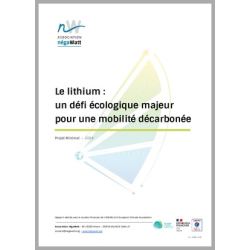
Le lithium : un défi écologique majeur pour une mobilité décarbonée
Etude/Recherche
Mis en ligne le : 29/04/2025
Minimal project
The fight against climate change is now a major challenge: it is essential to maintaining current living conditions on Earth. Nevertheless, as important as it is, this environmental challenge is far from being the only one. The collapse of biodiversity, air, water, and soil pollution, and the eutrophication of aquatic environments are all other causes for concern, often interconnected. The causes of these phenomena are well known; many human activities contribute to them, including mining and metallurgy. But can we really stop this extraction in the short, medium, or long term? To minimize the rise in Earth’s surface temperature as much as possible, it is essential to reduce greenhouse gas emissions. However, in various sectors, the decarbonization of human activities requires increased consumption of mineral resources— and thus the associated environmental impacts. This issue is a challenge for the future, as the energy transition currently accounts for only a minimal share of the overall environmental impacts of mining and metallurgy. To reduce the impacts associated with mining and metallurgy, we must therefore consider the uses of metals as a whole, rather than focusing solely on those related to the energy transition. Given these observations, what are the actual metal requirements to ensure good living conditions on Earth and to support the energy transition? How can we prioritize these needs to reconcile the energy transition with reduced extraction? And finally, how can we ensure a minimum level of global equity in access to mineral resources?
The fight against climate change is now a major challenge: it is essential to maintaining current living conditions on Earth. Nevertheless, as important as it is, this environmental challenge is far from being the only one. The collapse of biodiversity, air, water, and soil pollution, and the eutrophication of aquatic environments are all other causes for concern, often interconnected. The causes of these phenomena are well known; many human activities contribute to them, including mining and metallurgy. But can we really stop this extraction in the short, medium, or long term? To minimize the rise in Earth’s surface temperature as much as possible, it is essential to reduce greenhouse gas emissions. However, in various sectors, the decarbonization of human activities requires increased consumption of mineral resources— and thus the associated environmental impacts. This issue is a challenge for the future, as the energy transition currently accounts for only a minimal share of the overall environmental impacts of mining and metallurgy. To reduce the impacts associated with mining and metallurgy, we must therefore consider the uses of metals as a whole, rather than focusing solely on those related to the energy transition. Given these observations, what are the actual metal requirements to ensure good living conditions on Earth and to support the energy transition? How can we prioritize these needs to reconcile the energy transition with reduced extraction? And finally, how can we ensure a minimum level of global equity in access to mineral resources?
Documents associés
Etude/Recherche
Mis en ligne le : 29/04/2025
COPPER - How to combine resilience and sustainability
Découvrez aussi
Mis en ligne le : 31/10/2025
Mis en ligne le : 30/07/2026
Mis en ligne le : 30/06/2026
Mis en ligne le : 12/09/2025
Mis en ligne le : 30/06/2026
Mis en ligne le : 30/03/2026
Mis en ligne le : 30/03/2026