

MODECOM 2024 - Campagne nationale de caractérisation des déchets ménagers et assimilés
Etude/Recherche
Mis en ligne le : 19/12/2025
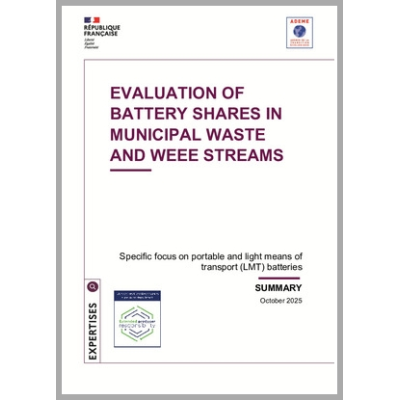
Specific focus on portable and light means of transport (LMT) batteries
The proper management of household and municipal waste requires a precise understanding of its composition. It is indeed an essential driver for guiding public policies, optimizing collection systems, and developing efficient recycling operations.
Batteries, and more specifically portable batteries, are increasingly present in our waste. This represents an environmental and safety threat, particularly due to the fire risk associated with the presence of certain types of batteries in mixed waste streams.
This study has been conducted in accordance with (EU) 2023/1542 battery regulation and aims to quantify the share of different types of waste batteries (portable batteries and batteries in light means of transport) in two major waste streams: mixed municipal waste (based on the national MODECOM™ 2024 campaign) and waste electrical and electronic equipment (WEEE), based on data from producer responsibility organizations.
The results of this study show that in 2024, over 7,500 tonnes of portable batteries can be found in mixed municipal waste (residual household waste, separate multi-material collection, and waste collection centers). This represents approximately 20% of the estimated total waste generated.
This data is essential to improve sorting, reduce risks, and the proper redirection of this waste towards reuse or recycling operations.
The proper management of household and municipal waste requires a precise understanding of its composition. It is indeed an essential driver for guiding public policies, optimizing collection systems, and developing efficient recycling operations.
Batteries, and more specifically portable batteries, are increasingly present in our waste. This represents an environmental and safety threat, particularly due to the fire risk associated with the presence of certain types of batteries in mixed waste streams.
This study has been conducted in accordance with (EU) 2023/1542 battery regulation and aims to quantify the share of different types of waste batteries (portable batteries and batteries in light means of transport) in two major waste streams: mixed municipal waste (based on the national MODECOM™ 2024 campaign) and waste electrical and electronic equipment (WEEE), based on data from producer responsibility organizations.
The results of this study show that in 2024, over 7,500 tonnes of portable batteries can be found in mixed municipal waste (residual household waste, separate multi-material collection, and waste collection centers). This represents approximately 20% of the estimated total waste generated.
This data is essential to improve sorting, reduce risks, and the proper redirection of this waste towards reuse or recycling operations.
Documents associés
Etude/Recherche
Mis en ligne le : 19/12/2025
Etude/Recherche
Mis en ligne le : 13/02/2026
Evaluation of battery shares in municipal waste and EEE streams
Découvrez aussi
Mis en ligne le : 31/07/2025
Mis en ligne le : 31/07/2025
Mis en ligne le : 31/07/2025
Mis en ligne le : 31/07/2025
Mis en ligne le : 31/07/2025
Mis en ligne le : 31/07/2025
Mis en ligne le : 31/07/2025
Mis en ligne le : 31/07/2025
Mis en ligne le : 31/07/2025


